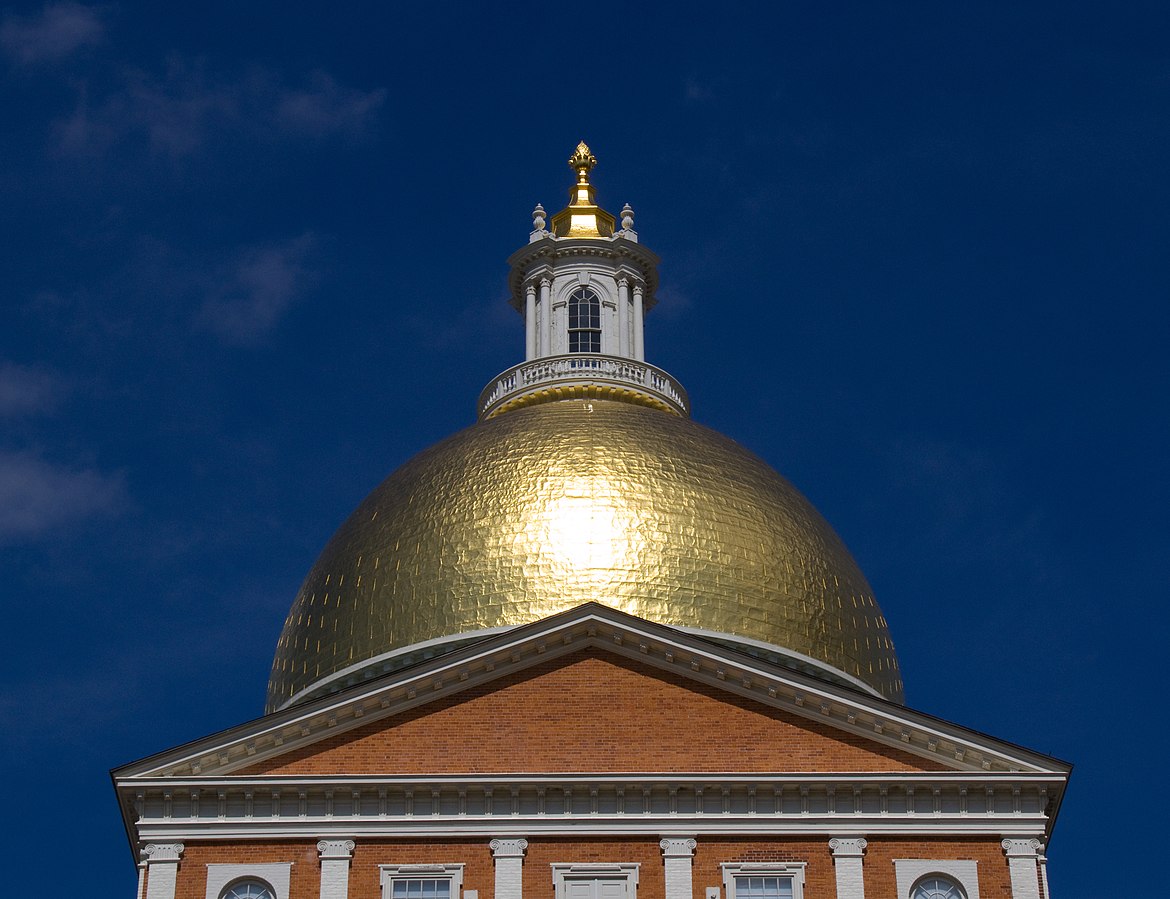
Massachusetts State House
The Massachusetts State House, designed by Charles Bulfinch and completed in 1798, is one of the most iconic civic buildings in the United States. Its prominent dome—now a defining feature of the Boston skyline—has undergone several transformations over time. Originally constructed with wood shingles, the dome soon proved vulnerable to leaks, prompting Paul Revere’s company to sheath it in copper. The dome was later painted in subdued tones before being gilded with gold leaf in 1874. During World War II, the gold finish was concealed under gray paint to reduce visibility during blackouts, and the dome was subsequently re-gilded in 1969.
By the late 20th century, the gilded surface had again deteriorated, requiring a comprehensive restoration. In 1997, EverGreene partnered with M.L. McDonald to re-gild the dome, undertaking a full exterior treatment to restore both its appearance and durability. The project began with the careful removal of the existing, weathered gold leaf and coatings, followed by thorough surface preparation and priming of the copper substrate to ensure proper adhesion. EverGreene craftsmen then applied 23.75 karat gold leaf across the dome, reinstating its luminous finish and reinforcing its role as a visual landmark.
The regilding required careful coordination and specialized access to safely navigate the dome’s curved surface, as well as attention to environmental conditions to achieve a consistent application. The completed work returned the State House dome to its historic brilliance, ensuring long-term protection while preserving one of Boston’s most recognizable architectural features.