Richard Haas Murals
Richard Haas is an American muralist who is masterful in his use of the trompe l’oeil (French for “trick the eye”) technique to create larger than life architectural illusions, which introduce realism into a two-dimensional landscape. Using buildings as his canvas, Haas creates life-sized murals which include representations of windows, doors, and other architectural features which are integrated into the design of the building in a way that appear three-dimensional to the casual observer. As described by the Washington Post, Haas’s use of the technique is “a curious border zone between architecture and art, building and decoration.” His murals are most often used to revitalize neglected spaces and can serve to inject new life and beauty into an entire area.
EverGreene has had a longstanding relationship with Haas, scaling and executing numerous murals across the US since the 1980s. Color maquettes designed by Haas are taken by EverGreene and executed in full scale on the selected architectural surfaces. The works were painted directly on the surface with Keim mineral paints. The paints are wind, sun, and moisture resistant while retaining vapor-permeability, which is perfect for outdoor use on architectural surfaces. EverGreene’s work includes:
Exterior Richard Haas Murals
Homage to the Chicago School, 1211 North Lasalle Street, Chicago (1980). Painted on three sides of 18 floor apartment house, it mimics the appearance of the finished front facade and is an homage to Louis Sullivan’s design.
Homewood Murals, Homewood, Illinois (early 1980s). 15 murals scattered around the town, depicting themes of community, architecture, transportation, and family.
Bradley Symphony Center, Milwaukee, Wisconsin (1981). A series of windows and a large central faux glass panel that reflects both buildings which are no longer standing along Wisconsin Avenue, including the Pabst Building and the former Lake Front Depot, as well as some that are, like the former Gimbels building.
Homage to Cincinnatus, Brotherhood Building, Cincinnati, Ohio (1983). The mural depicts a central marble statue of Lucius Quinctius Cincinnatus, the Roman statesman for whom the city was named.
2300 Chestnut Street, Philadelphia, Pennsylvania (1983). An office building, which was transformed into a labyrinth of arched openings that contain a figure of William Penn, painted from Thomas Eakins’ painting Max Schmitt in a Single Scull
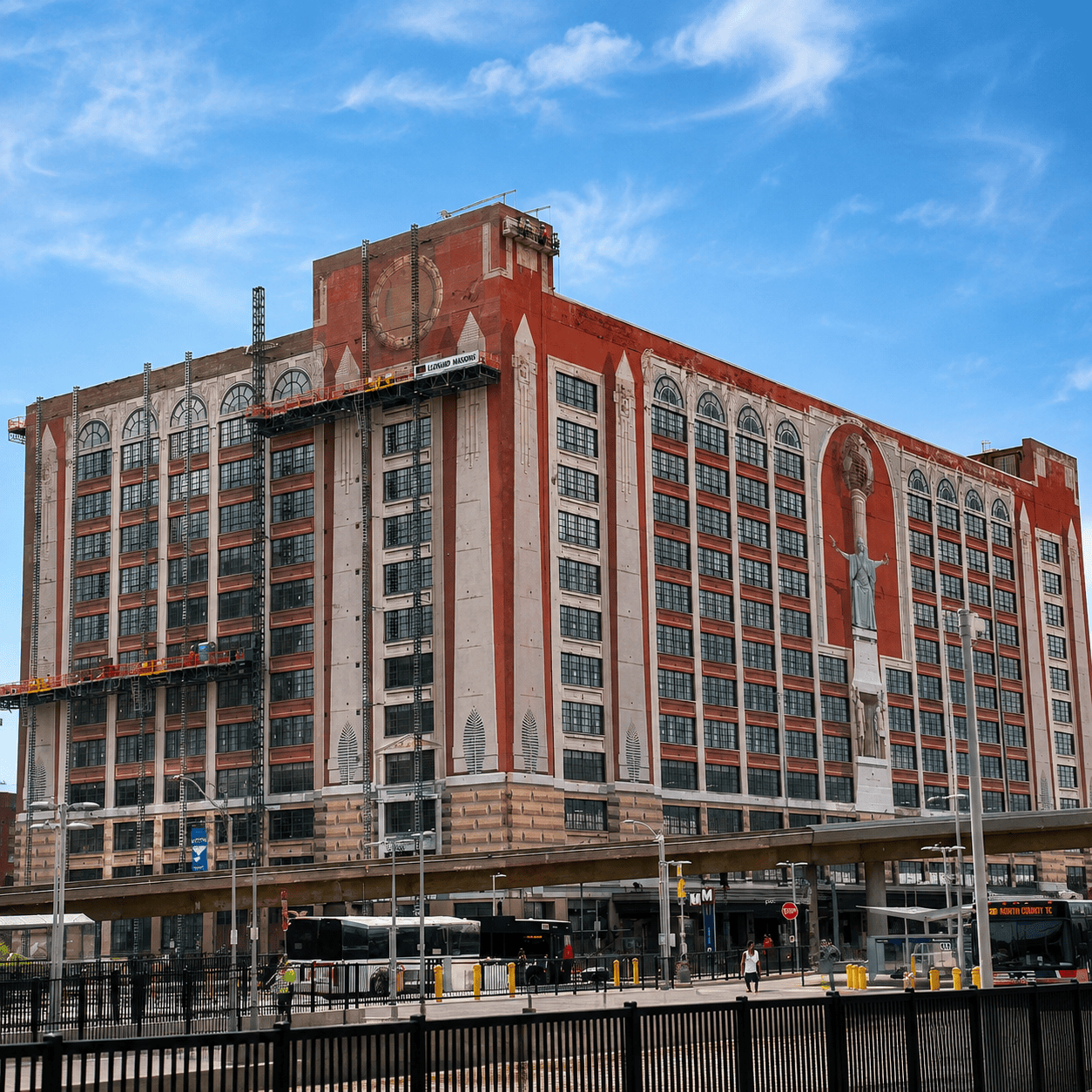
Edison Brothers Stores, Inc. St Louis, Missouri (1984). Three sided mural with eight obelisks at its corers, a painted sculpture of Peace on the west facade, and a painted equestrian state of St Louis on the south facade.
Lincoln Building Mural, Washington, DC (1985). Painted on the building adjacent to the house where Abraham Lincoln died and opposite Ford’s Theater where he was shot. The mural depicts Lincoln as a young man.
Gateway to the Waterfront, Yonkers, New York (1997). Painted as part of major downtown improvements to the City of Yonkers. Three murals painted on three buildings, which depict figures and episodes in Yonkers history, including indigenous peoples, Dutch settlers, an 18th century English village, and late 19th century industrialism.
Fulton Theatre, Pittsburgh, Pennsylvania (1993). Representation of a stage where Pittsburgh’s steel legacy is depicted, including the a steel mill interior, where furnaces are pouring hot metal.
National Cowgirl Museum and Hall of Fame, Fort Worth, Texas (2002). Depicts five cowgirls on horseback, riding in full gallop straight towards the viewer.
The Dwelling Place, Grand Rapids, Michigan (2003). Painted as a part of the Heartside Neighborhood Redevelopment project, which is part of the Dwelling Place, whose mission is to improve people’s lives by creating quality affordable housing, providing essential support services, and promoting neighborhood revitalization.
Downtown Doral Charter Elementary School, Doral, Florida (2015). Two murals painted on the façade of the Doral Charter Elementary School.
Interior Richard Haas Murals
100 North Plaza, Paragon Group, Inc, Tampa, Florida (1993)
Bank One Ball Park Arizona Diamondbacks, Phoenix, Arizona (1998). Depicts sports throughout history, including the local Arizona Diamondbacks baseball team, as well as depictions of the rich topography of Arizona.
Pergola of Justice, Sarasota County Courthouse, Sarasota, Florida (1998). Depicts a series three-dimensional arcades and pergolas, which frame an image of Justice in the center and adorned with garden foliage.
Richard Haas Mural Restorations/Alterations
The Chisolm Trail, Fort Worth, Texas (originally made 1988). Covers an outer wall of the Jett Building in downtown Fort Worth. Over the years parts of the mural fell into disrepair. EverGreene worked directly with the artist to redesign segments of the mural, helping to once again visually unify all of the sections of the mural with the rest of the building. New doorways and a new fountain were also incorporated into the design, in order to further connect the surrounding environment with the mural.
The Peck Slip Arcade, New York, New York (originally made 1978). Painted on the wall of a Consolidated Edison building on Peck Slip, the mural depicts a classical colonnade, with a view to the Brooklyn Bridge. The mural had begun to deteriorate over time, so EverGreene was contracted to restore the mural to its original visage.