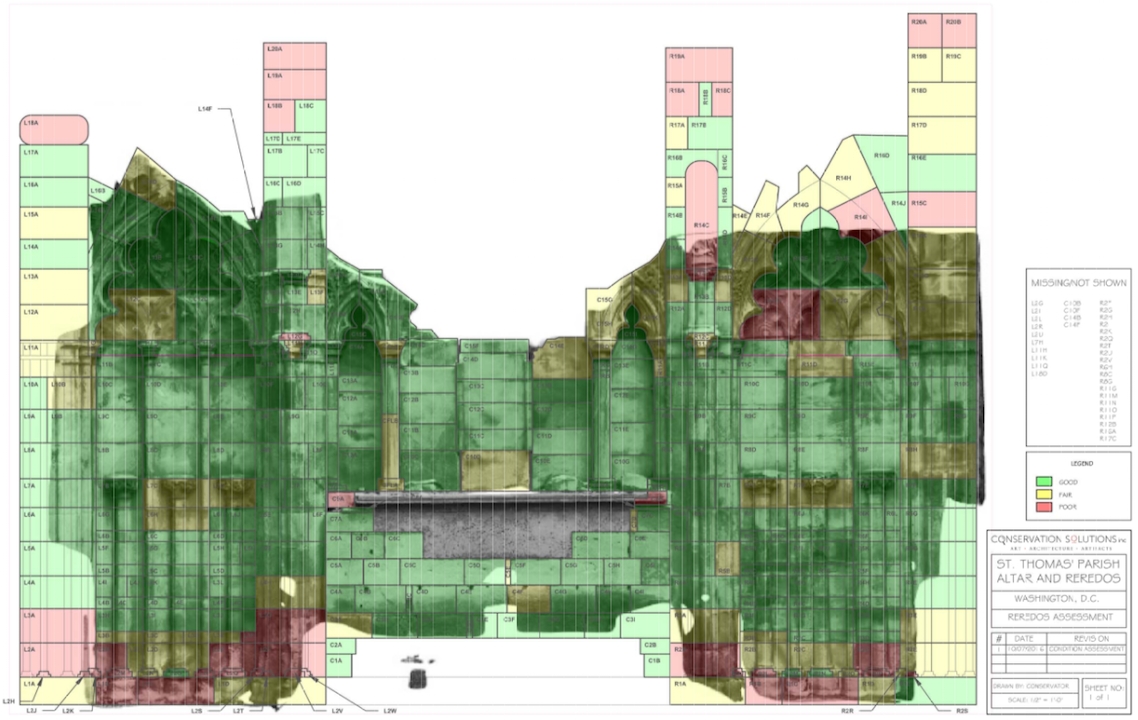
St. Thomas Altar & Reredos Assessment
St. Thomas Episcopal Church, located in the Dupont Circle neighborhood of Washington, D.C., was constructed between 1894 and 1899. Designed by architect Theophilus P. Chandler, the Neo-Gothic Latin-cross plan church originally accommodated 850 congregants and featured a lantern tower rising 100 feet above the crossing. The church was subject to arson in 1970, leaving only fragments of the original structure, including the altar and reredos at the east end of the property. The congregation committed to maintaining the site by establishing a park and protecting the ruins, while the remaining church was demolished due to structural instability.
In 2016 EverGreene was contracted by St. Thomas Church to perform a comprehensive assessment of the altar and reredos ruins. The assessment was meant to assist in determining the reusability of the historic stones, as the client intended to reconfigure and reinstall the ruins in a newly constructed church building on the existing site. The overarching goal was to honor the history of the congregation—metaphorically reflected in the survival and renewal of the altar and reredos—while preserving the elements as a reconstructed ruin.
The team visually documented the condition of each stone, and prepared measured drawings and written records identifying the types of deterioration present and the typical conditions observed across the stone elements. The once interior ruins had mostly been unprotected and subjected to fluctuations of weather, unauthorized use, and biological colonization which have caused significant deterioration. Cracks/fractures, detachment, sanding, loss, erosion, mechanical damage, missing elements, various crusts and other deposits, graffiti, soiling, and biological growth were all noted conditions.
Information gleaned from the analysis assisted with development of plans for carefully cataloging, labeling, removing, and treating each stone in preparation for reconstruction in the new sacred space. This approach ensured that important pieces of the church’s heritage would continue to serve the congregation in their new home. As part of the construction of the new building in 2019, the altar and reredos were conserved and installed by others in a specially designed location within the new structure.