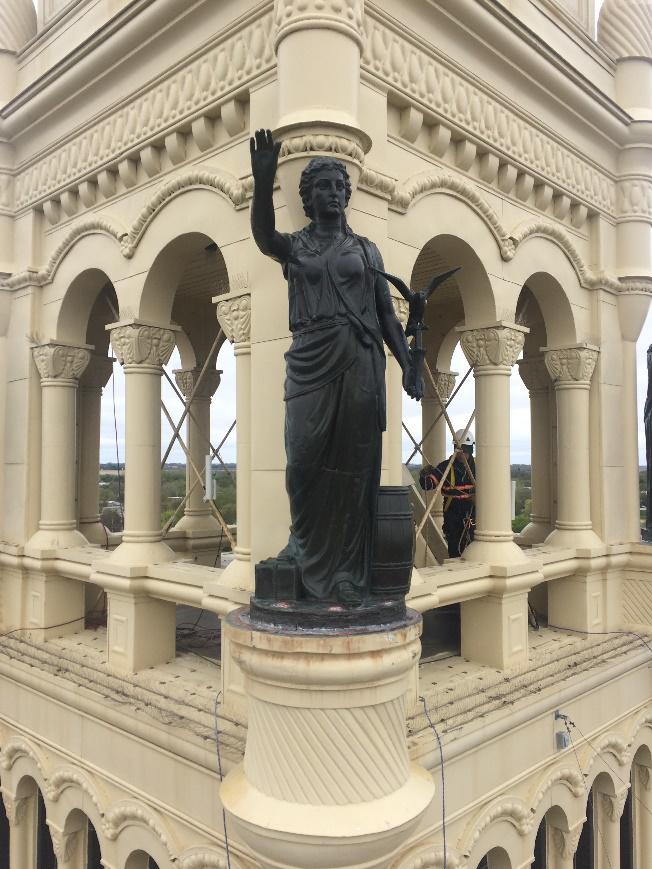
Franklin County Courthouse Sculptures
The Franklin County Courthouse in Hampton, Iowa, was designed by Minneapolis architect T.D. Allen and constructed between 1890 and 1891. During this time medieval revivals flourished, followed by a transition to Beaux Arts classicism. As symbols of strong government, prosperity, and growth, more elaborate structures were created. The building was added to the National Register of Historic Places in 1976.
EverGreene was contracted to perform condition assessments on five copper facade sculptures which adorn the clock tower of the Courthouse—four original to the building and one reconstructed as part of restoration in 1976. The original sculptures were fabricated in the repoussé method, in which copper sheets were hammered and soldered together to create a hollow structural skin, which was supported by internal tubular braces and a central galvanized steel “stovepipe” which provided rigidity and a mechanism for mounting to the structure. The sculptures exhibited conditions typical to exposed copper sculptures of the period: atmospheric soiling, superficial oxidation of copper skin, iron corrosion staining, failed soldered seams, detachment of internal armature, deformation of sculptural elements, and loss of sheet metal at the base of the plinths.
Following the assessment, EverGreene was engaged to remove and treat the sculptures. The goals of the treatment were to stabilize the internal armature systems, restore the structural integrity of the copper substrate, reestablish the visual unity through localized repairs and spot patination, and reinstallation of the sculptures in their original locations. The sculptures were soft-packed and transported to EverGreene’s facility in Maryland were the following treatments were implemented:
- Overall cleaning to remove soiling, remnant coating layers, and loose corrosion using a dilute anionic detergent in water
- Structural reinforcement of internal armature systems and stovepipe
- Treatment of rusted internal elements using a cleaner/degreaser and a rust-inhibiting primer
- Re-patination of the copper skin to a medium brown
- Application of two protective wax coatings—one hot wax microcrystalline coating and one cold wax coating—which were buffed to a medium sheen
Upon completion, the sculptures were transported back to Iowa and hoisted to the courthouse roof using two cranes. The sculptures were secured into place using new stainless steel rods and bolts topped with copper caps, which were soldered in place.