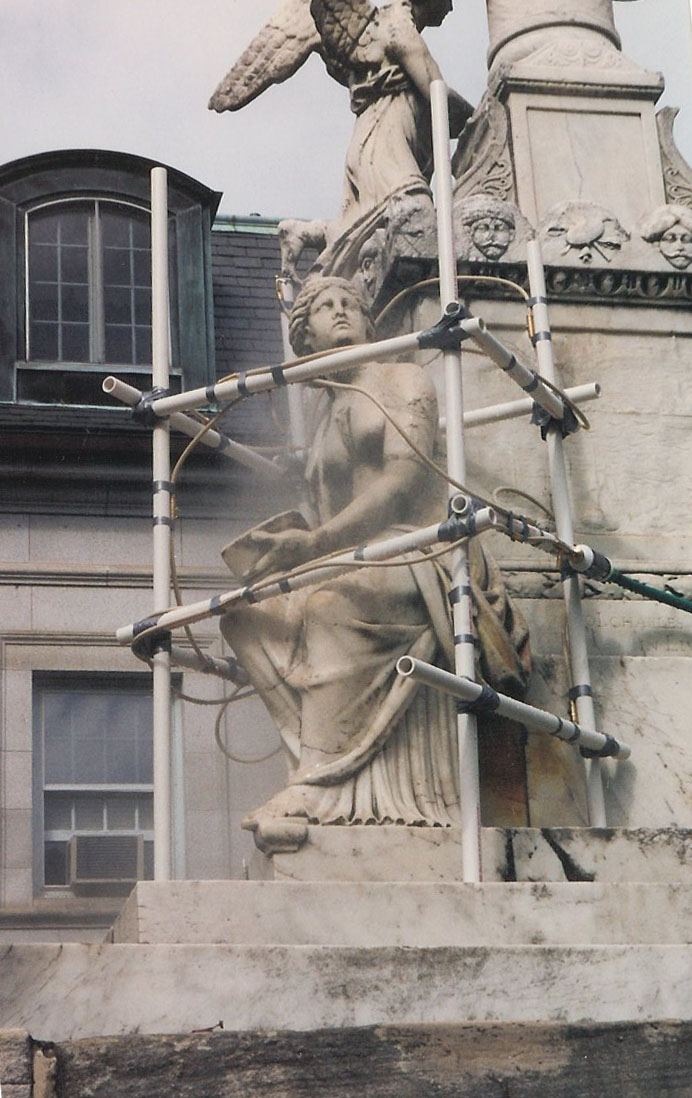
Tripoli Monument
The Tripoli Monument, originally known as the “Naval Monument,” was created in 1806 by Italian sculptor Giovanni Micali. It was erected to honor those who fought and died in the First Barbary War (1801–1805) against the Barbary pirates of North Africa, the first formal war conducted under the United States Constitution. Specifically, the monument commemorates five U.S. Navy officers and midshipmen who were killed in a battle at Tripoli in 1805. Initially installed at the Washington Navy Yard in 1808, the monument was relocated several times before reaching its current location at the United States Naval Academy in Annapolis, Maryland, in 1860.
The monument consists of a 30-foot-high column topped by an eagle and mounted on an elaborately adorned base featuring allegorical sculptures representing Glory, Fame, History, and Commerce. The sculpture rests on a square stone base composed of large masonry blocks and accented by an urn at each corner. Inscriptions on all four sides of the base provide information about the artist, the monument’s purpose, and memorials to those who lost their lives.
EverGreene was contracted to perform a condition assessment, microbial analysis, cleaning tests, and conservation treatments on the Tripoli Monument. Testing was performed to determine appropriate treatment methodologies for the soiling, biological growth, and gypsum crusts. However, significant tenacious biological staining was documented on all sides of the monument, appearing as red-orange and black stains on the surface. To more effectively address this condition, EverGreene collected and analyzed biological specimens to identify the organisms present. Testing revealed two fungal species, however the tenacity of the staining proved difficult to remove while protecting the integrity of the stone. Treatments of the monument included:
- Removal of biological growth, gypsum crusts, general soiling, and the red/orange fungal growth.
- Restoration of failed mortar joints and repointing
- Selective injection infilling of cracks in the marble
- Removal and replacement of deteriorated and/or inappropriate patches/infills
- Removal of deteriorated stone and performing patches or dutchman repairs
- Replacement of iron cramps used to secure the marble with stainless steel cramps
- Removal and replacement of pinning system for the angel’s wings, which included fully disassembly and reassembly of the wings
- Replacement of three of the urn necks, which had been fractured by expanding internal iron supports
- Repair of the single remaining urn neck
- Cleaning, removal of corrosion product, priming, and regilding of the four urn flames
- Inpainting of of red-orange staining at the Navy’s request, which could not be removed
A record of treatments performed well as continued maintenance recommendations were provided to the client upon completion of the work.