After the fall of the Berlin Wall, Iranian born artist Kani Alavi worked with other German artists including Jorg Weber to preserve a portion of the wall. Alavi had moved to West Germany in 1980, and his studio overlooked Berlin’s Checkpoint Charlie border crossing. Alavi was a firsthand witness to the cruelty and division that the wall represented. The artists’ organization sought to preserve and reimagine an over 4,000 foot long segment of the original Berlin Wall along the Spree River as an open-air gallery and monument to the experience of East Germans and others who sought freedom. This wall section, known as East Side Gallery, contains the work of 118 artists from 20 countries. The artists painted new works on the east-facing side of the wall.
“The Berlin Wall is perhaps the most visible expression of the moral gulf between free democracy and dictatorship.”
HELMUT KOHL, German Chancellor, August 14, 1984
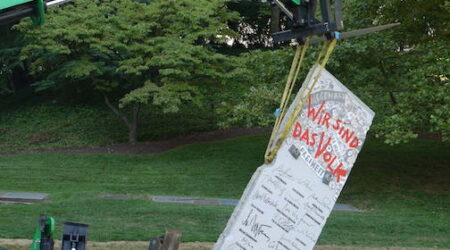
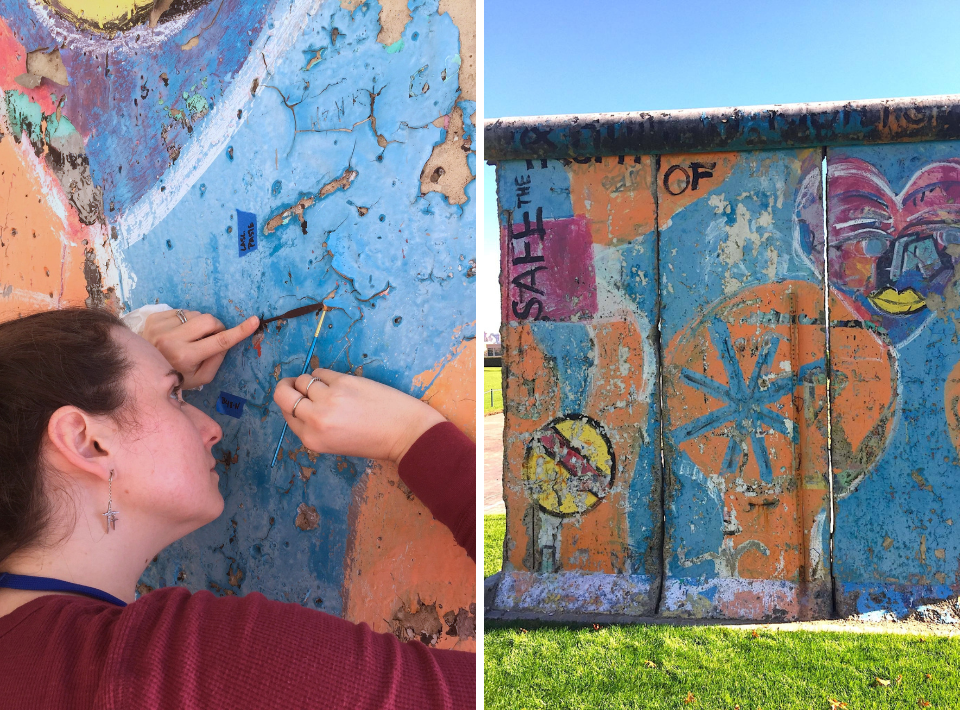
In 2002 a portion of the wall painted by Kani Alavi was donated to the United Nations sculpture garden in New York City. The wall section consists of three structurally distinct panels of steel reinforced concrete, with each panel measuring approximately 4 feet wide by 12 feet high. Alavi’s painting faces east just as it did in Berlin. It was painted before its arrival in the United States as a part of the East Side Gallery. The graffiti on the west facing side is by numerous artists and is thought to date from 1989-1990, while the wall still divided Germany. Alavi’s painting depicts two people embracing over the top of the wall, with the words “Trophy of Civil Rights” inscribed on the round wall cap above the image.
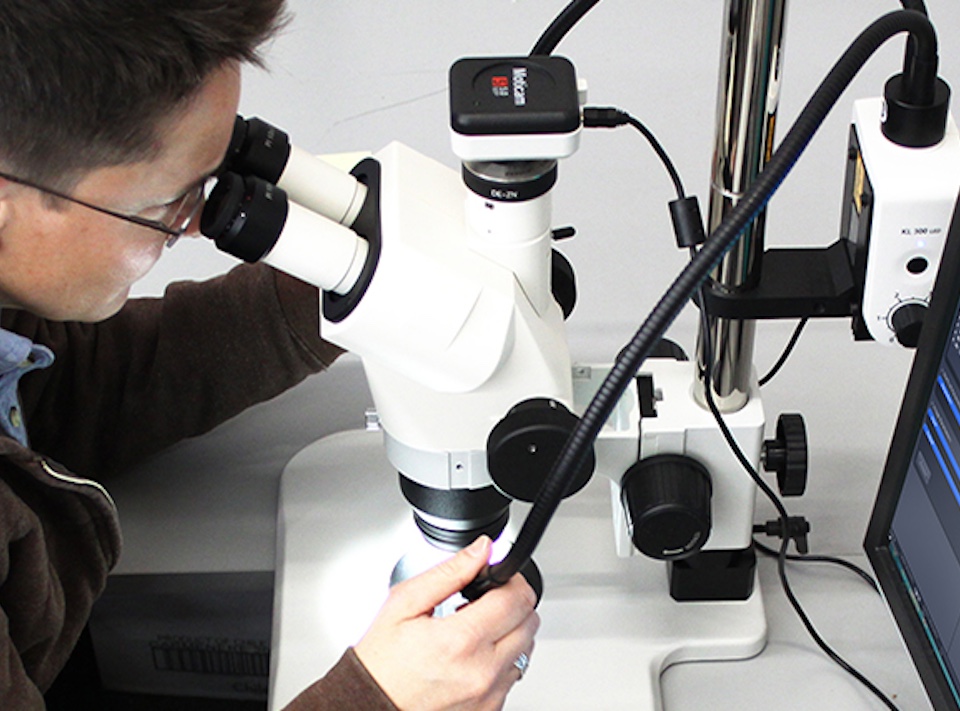
Between December 2016 and February 2017, EverGreene worked on the conservation of this wall section. The engagement involved conditions mapping, re-adhering paint layers, stabilizing the concrete substrate, and protecting the reinforcing steel from further degradation. The project did not encompass an in-depth, comprehensive treatment but provided temporary stabilization to slow down the rate of deterioration and save a significant portion of historic paint and imagery as an initial step towards preserving this monument and its significance into the future.
Authors: Brooke Russell, Mary Slater, and Gillian Randell.
Extract from APT Bulletin: The Journal of Preservation Technology, 2024, Vol. 54, No. 1/2
Special Issue: Graffiti (2024), pp. 33-40